A lift truck may have been operating safely at the end of one shift, but that does not automatically mean it is safe for the next operator.
Damage, wear, leaks and faults can develop during use or while equipment is parked. A proper pre-use inspection gives the operator an opportunity to identify these problems before the truck is put into service.
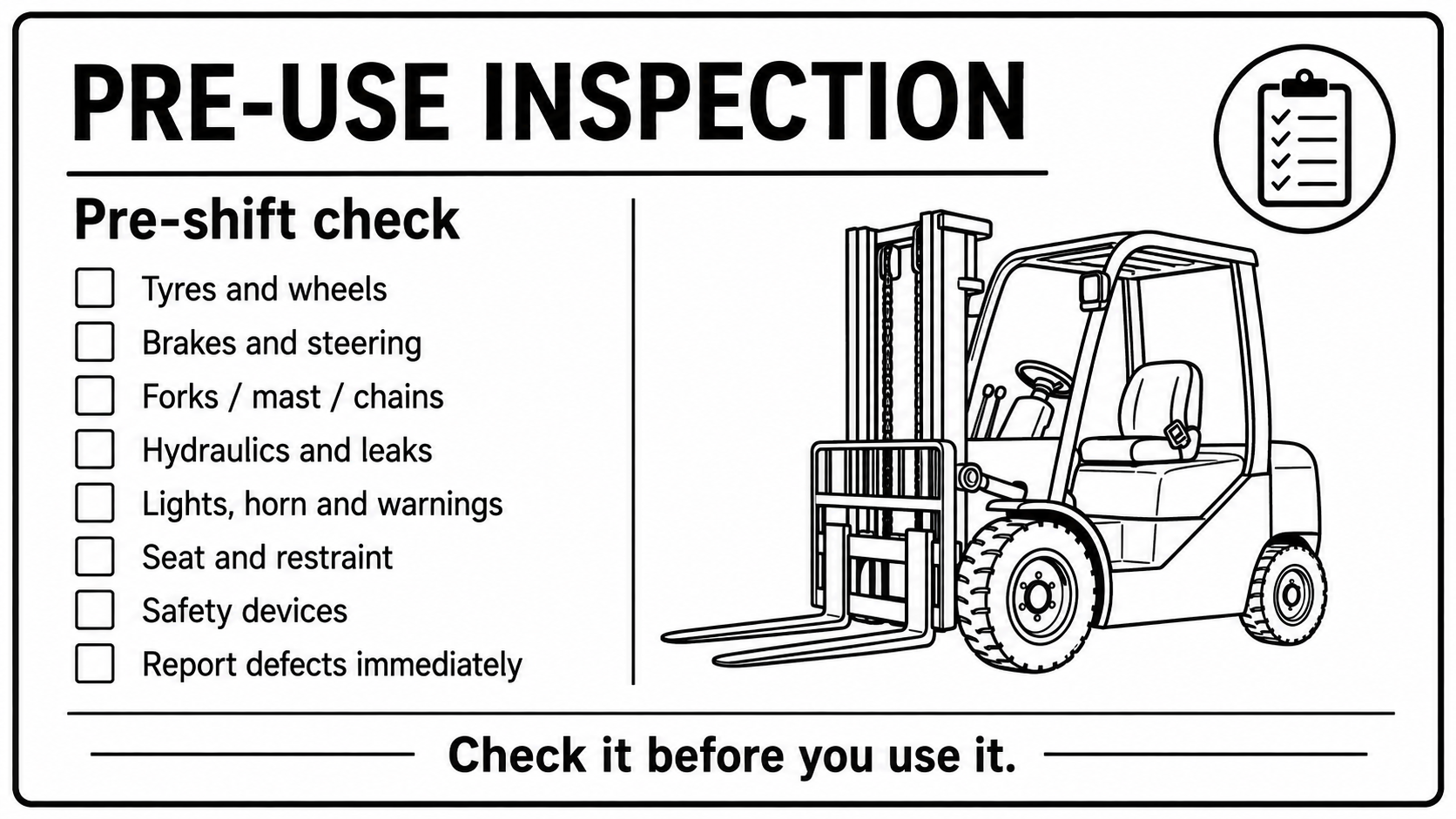
HSE’s Approved Code of Practice and guidance, L117, refers to this as a pre-shift check. It states that operators should check the lift truck at the beginning of each shift, in accordance with the vehicle handbook, and that the results should be documented.
This is not simply paperwork or a box-ticking exercise. It is one of the most important steps an operator can take to protect themselves, colleagues, pedestrians and the wider workplace.
What should be checked?
The precise checks will depend on the truck, its power source, attachments and the manufacturer’s instructions.
A typical pre-shift check may include:
- tyres, wheels and wheel security
- brakes and steering
- forks, mast, boom, chains and attachments
- hydraulic systems and visible leaks
- battery condition or fuel system
- lifting and tilting controls
- horn, lights and warning devices
- mirrors and visibility aids
- operator seat and restraint system
- capacity plates and safety information
- load-moment or overload warning systems, where fitted.
Some checks are visual and should be completed before starting the truck. Others require a controlled functional check once it has been started.
Operators should always follow the vehicle handbook, manufacturer’s instructions and the employer’s checking procedure. A generic checklist should not replace machine-specific information.
More than a checklist
A completed form has little value if the truck has not actually been inspected.
Operators need to understand:
- what acceptable condition looks like
- what damage or deterioration to look for
- which defects may affect safe operation
- how to report a fault
- when the truck should be taken out of use.
The purpose of the check is not simply to create a record. It is to make an informed decision about whether the truck is safe to operate.
What happens when a defect is found?
Any defect that may affect safe operation should be reported immediately through the employer’s defect-reporting process.
Where a defect is safety-critical, the lift truck should not be used until the fault has been rectified.
Operators should never ignore a fault because the job is urgent, the truck still moves, or another operator has continued to use it. Employers must also ensure that reported defects are investigated and acted upon.
A strong safety culture supports operators who stop and report unsafe equipment.
Pre-shift checks do not replace maintenance
A pre-shift check is only one part of keeping a lift truck safe.
It does not replace:
- planned maintenance
- servicing
- regular safety inspections
- statutory thorough examination.
Each process has a different purpose. A pre-shift check identifies readily apparent faults before operation. Maintenance and servicing keep the truck in safe working condition, while thorough examination is a more detailed statutory process relating to lifting equipment and safety-critical components.
All are necessary.
Increasing the focus within ABA testing standards
Pre-shift checks are already reflected within L117 as an important part of operator training and testing.
The Accrediting Bodies Association for Workplace Transport is preparing to review and update its lift truck testing standards. As part of this work, the ABA will consider how pre-shift checks can be given greater prominence and assessed more consistently.
The aim is not simply to add more questions or require a longer checklist. Operators should be able to demonstrate that they can:
- inspect the truck systematically
- recognise relevant defects
- explain why those defects matter
- report problems correctly
- identify when a truck should not be used.
Safe operation involves more than driving and handling loads. It begins with establishing whether the equipment is safe to use.
Start safe
Take the time to inspect the truck properly. Follow the manufacturer’s instructions, record the results and report defects promptly.
A few careful minutes at the beginning of a shift can prevent a much more serious incident later.